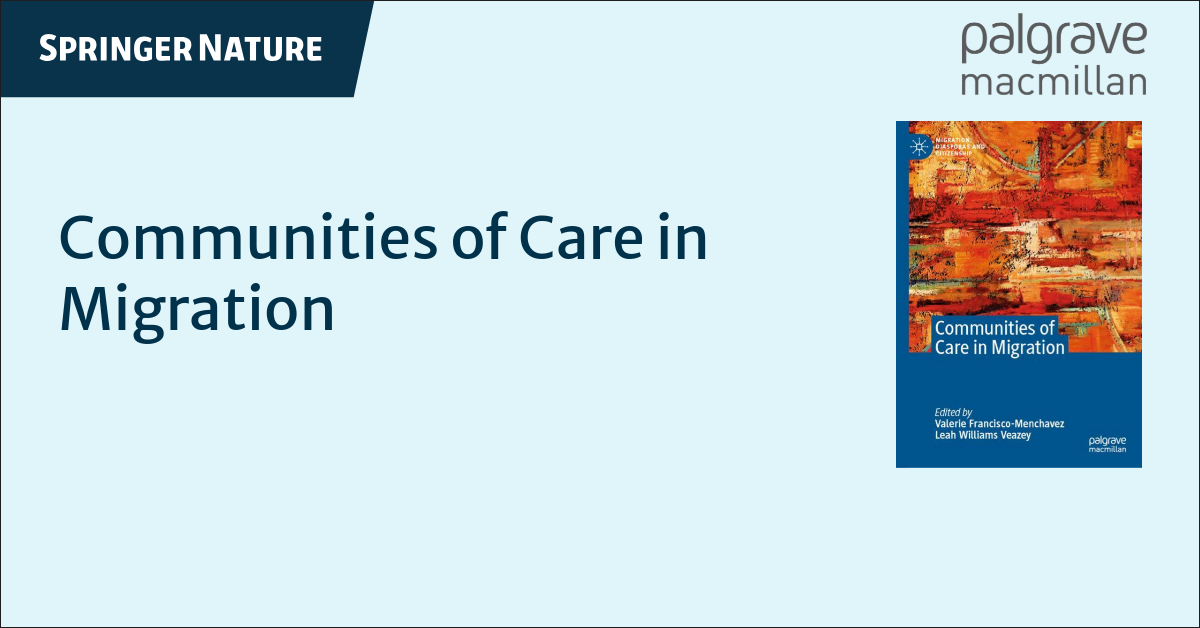
I am delighted to announce that my latest book has been published with Palgrave Macmillan. An edited collection, on the topic of Communities of Care in Migration, the book explores local and transnational relationships and practices of care as collectively produced and enacted in the lives of migrants in diverse contexts, including the USA, Canada, Australia, South Africa, Asia, Europe, and online.
The collection brings together chapters by leading and emerging scholars from a range of disciplinary backgrounds and also includes contributions from community organisers and practitioners, offering a unique, praxis-informed perspective on the topic of how migrants care for each other.
I am proud to have curated this collection, alongside my co-editor, Valerie Francisco-Menchavez, which highlights migrants’ strategies of survival and solidarity, as well as the joy and friendship that sustains a life in migration. The book is available to buy now (or ask your library).
“This important new book reminds us that economics is only part of the story of human movement. As the rich and thoughtful chapters demonstrate, migrants participate in communities of care that are always complex, sometimes subversive and often gendered. With examples from across the world, this collection offers an insightful discussion of ethics, politics and emotions that is a valuable contribution to our understandings of migration, care and community.”
—Raelene Wilding, Professor of Sociology, La Trobe University, Australia
“Francisco Menchavez and Williams Veazey’s edited collection is a masterpiece. It brings together scholars and scholar-activists from different global regions to unpack the varied manifestations of “communities of care” globally. For the editors and authors, communities of care are multi-directional, relational and political, and emerge in opposition to long-standing structural inequities. This volume is a must-read for those who are interested in seeing other ways of doing and being in a world that is increasingly dominated by authoritarian and fascist values.”
—Ethel Tungohan, Canada Research Chair and Associate Professor of Politics, York University
 Leah Williams Veazey